
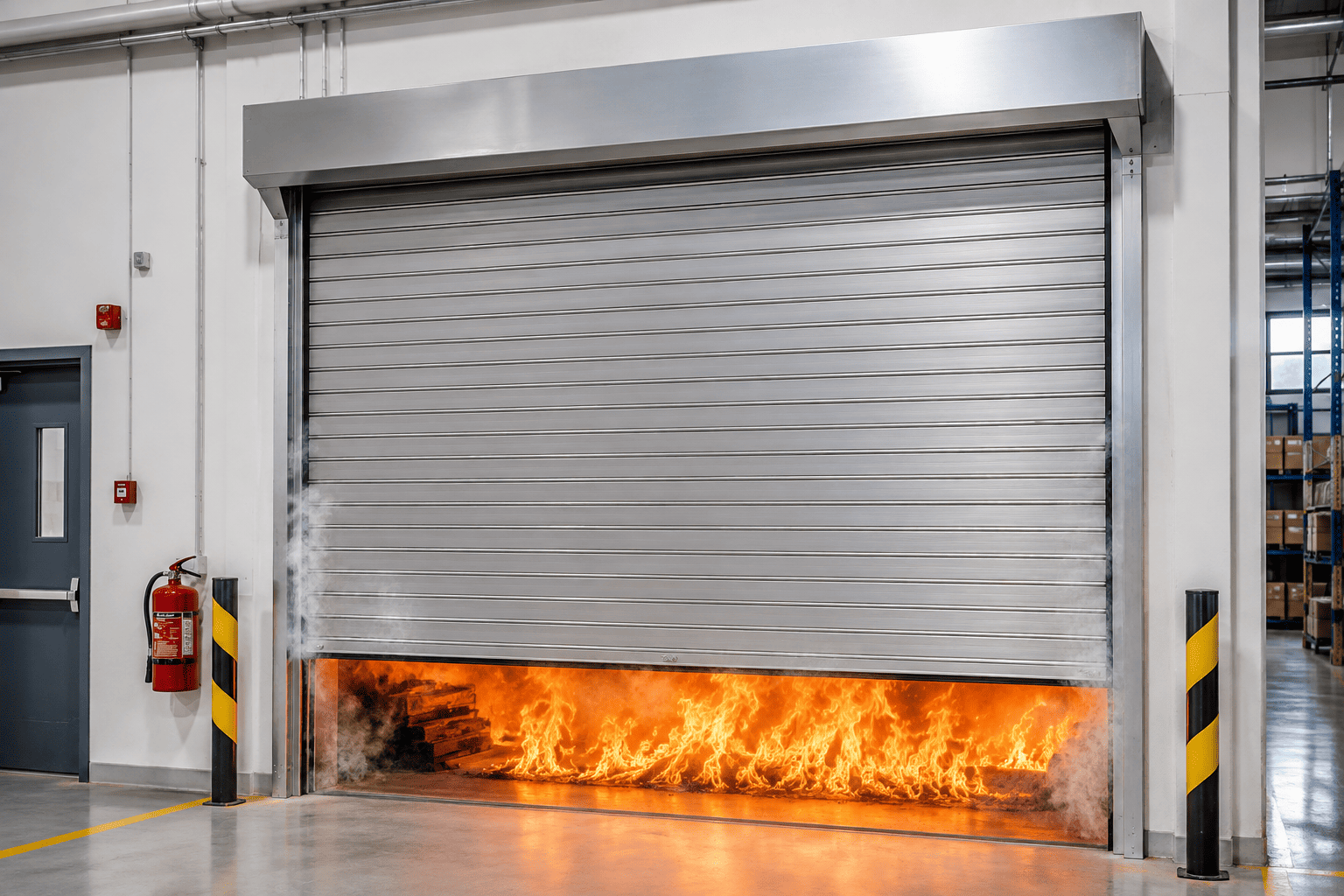
A fire-rated shutter is a rolling shutter built to resist flames and smoke for a tested period, often ranging from 30 minutes to 120 minutes depending on the product and requirement. The shutter remains open during normal operation and automatically closes when triggered by a fire alarm, heat sensor, smoke detector, or an authorised release system.
In this blog, we will explore the workings of fire-rated shutters, the necessity of fire-rated buildings, and the importance of fire-rated shutters in an emergency.
What Is a Fire Rated Shutter?
At its core, a fire-rated shutter is a steel slat curtain supported by a trigger and closing system. It will not extinguish a fire. Instead, it restricts fire and smoke movement between building sections during the first critical minutes of an incident.
The curtain material and closing mechanism are tested in a furnace for a specific time rating. This rating shows how long the shutter can maintain its integrity under fire conditions. In India, this testing is generally aligned with IS 3614, which sets standards for resistance against flame penetration and heat transfer before a shutter can carry a rating in minutes.
These parts work together to make the shutter respond safely during a fire emergency:
- Steel or galvanised curtain slats form the fire barrier.
- Thermal fuses or smoke detectors trigger the closing sequence.
- The mechanism allows the shutter to close using gravity or motor support, even during a power cut.
- Time ratings, commonly 30, 60, 90, or 120 minutes, indicate tested performance.
Why Your Building Needs One
Fire spreads through a building faster than most people expect, often moving from one area to another within minutes. A fire-rated shutter is not just another piece of equipment on a safety checklist. It offers people more time to do anything, helps to protect precious objects, and decreases the risk of one fire affecting the whole structure.
Insurance companies, fire officials, and building inspectors often exceed compliance requirements. For them, a working fire barrier means a property has a stronger emergency control strategy.
This makes fire-rated shutters useful for emergency planning:
- Occupants get extra time to reach exits safely.
- A properly planned fire protection system can also support insurance and audit discussions by reducing the overall risk profile of the property.
- Structural damage is limited to a single zone rather than a facility.
- Once the fire is contained within a box, it is easier for the fire department to respond.
Also Read: How Important is Annual Maintenance for Automatic Shutters
Problems We Help You Solve
Most of our clients come to us after realising their existing setup has a gap, not before they realise it. A warehouse might have open bays between storage zones. A factory may have a service corridor that lacks a fire barrier. These openings escalate a contained incident into a much bigger one.
Those are the weak spots where we put fire-rated shutters to close the compartments that would otherwise be open for the travel of flame and smoke.
- Uncontrolled fire spread between adjoining units gets stopped at the shutter line.
- Smoke inhalation risk drops when corridors and stairwells stay clear during evacuation.
- Tested rating equipment addresses non-compliance during fire safety audits.
- Loss of goods and machinery is reduced as damage is restricted to one part
Where Fire Rated Shutters Are Used
There is a point in every high-risk industrial and commercial environment where fire protection becomes more important than convenience. In these locations, the key issue is not simply shutting an opening but managing the movement of fire, heat, and smoke throughout the building. Fire-rated shutters serve to create this control, separating dangerous zones from occupied areas, valuable assets, and critical operations.
Common application areas include:
- Warehouses rely on them to protect high-value inventory across separate storage bays.
- They are used in factories around areas of machinery having a higher fire load.
- Malls and business buildings put them up near kitchens, generator rooms and parking entrances.
- Hospitals and data centres depend on them to protect critical, hard-to-replace equipment.
What to Check Before Installing a Fire-Rated Shutter
Not every opening requires the same specification, and the difference is typically discovered when an audit takes place or when a real incident occurs. A brief planning discussion before installation will save many hours of correction work afterwards.
Before finalising any fire-rated shutter, we guide the clients through a couple of decisions, as we realise that each fire-rated shutter will alter the product, cost, and approval process.
- Required fire rating, based on occupancy type and local fire code.
- Opening size and structural support, since larger spans need reinforced tracks.
- Activation method, whether alarm-linked, heat-triggered, or manually released.
- Location within the building, particularly near exits, stairwells, and high-load areas.
- Maintenance access, so the shutter can be tested and serviced without disruption.
- Get a fire safety sign-off from a fire safety consultant or the local fire department, where required.
Also Read: Comparing Insulated vs. Uninsulated Shutters
Why Choose Glidemaster
In 1982, we started manufacturing automatic rolling shutters, and we were the first professional brand in India in this category. That history is important because you don’t want fire safety equipment from a supplier that’s still learning the basics.
Glidemaster‘s 50,000 sq. ft. facility in Kerala has in-house research, design, and manufacturing all in one place. We utilise foreign machinery and proven materials to meet worldwide quality standards, not minimum standards, just to pass inspection. Our fire-rated shutters are manufactured with tested materials and specifications that can be aligned with required fire safety standards, including IS 3614-based project requirements where applicable.
Clients across Kerala and the rest of India choose us because our shutters are supplied, installed, and supported by the same company that designed them. There is no mediator between the people who manufacture the shutter and those who support it after installation. To explore the right fire-rated shutter solution for your building, you can contact our team and choose a system that matches your safety requirements, building layout, and daily operations.